Tree Bookshelf Pros and Cons: What to Know Before Buying

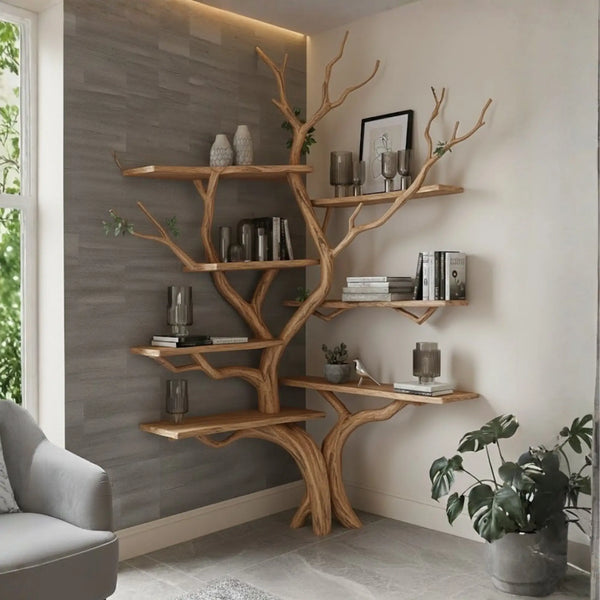
A tree bookshelf turns vertical wall space into a sculptural display that holds 30 to 80 books while occupying less than 2 square feet of floor area. The design mimics the trunk-and-branch structure of a tree, with asymmetric shelves that fan outward at different heights. This shape makes tree bookshelves a strong choice for small rooms, tight corners, and apartments where a traditional rectangular bookcase would consume too much floor space. But the same narrow profile that saves space also creates stability limitations, weight restrictions per branch, and material concerns that every buyer needs to evaluate.
The 5 Biggest Pros of a Tree Bookshelf
1. Vertical Space Saving in Small Rooms
Tree bookshelves stand 4 to 6 feet tall and occupy a floor footprint of roughly 1.5 to 2 square feet. A standard rectangular bookcase of comparable height requires 3 to 4 square feet of floor space, sometimes more when accounting for the depth of 12 to 15 inch shelves.
This footprint difference matters most in three situations:
Studio apartments: When a single room serves as bedroom, living room, and workspace, every square foot of floor area affects how the room functions. A tree bookshelf provides book and decor storage without blocking sightlines or dividing open space.
Narrow hallways and entryways: A tree bookshelf's 1 to 2 foot depth fits into corridors and foyer areas where a traditional bookcase would obstruct foot traffic.
Unused corners: Corner-specific tree bookshelf designs convert 90-degree wall intersections into usable display areas. These corners typically go empty because standard furniture does not fit their angular geometry.
2. Sculptural Focal Point That Doubles as Art
Most furniture serves a function but does not attract visual attention. Tree bookshelves break this pattern. Their organic silhouette, with branches extending at irregular angles, makes them a natural focal point in any room. Interior designers at DT Wood Decor describe the tree bookshelf as "architectural art" because it introduces organic curves and asymmetry to spaces dominated by rectangular furniture.
This dual purpose (storage plus visual interest) reduces the number of items a room needs. A tree bookshelf eliminates the need for a separate decorative shelf, a standalone art piece, or a display pedestal. The bookshelf itself fills all three roles.
The sculptural effect works across multiple design styles. Rustic interiors benefit from raw wood tree bookshelves with bark-edge details. Minimalist rooms use white-painted or light-toned models as clean visual statements. Scandinavian spaces pair natural pine tree bookshelves with neutral furnishings.
3. Versatile Display Beyond Books
Tree bookshelf branches accommodate more than book spines. The tiered, asymmetric shelves create natural resting places for small potted plants, framed photographs, candles, decorative objects, and ambient lighting like small LED strands.
This versatility encourages a curated, layered display rather than a wall of book spines. Styling a tree bookshelf follows similar principles to floating shelf arrangement: mix heights, combine materials, use odd-number groupings, and leave some branches intentionally empty for visual breathing room. The visual triangle method (placing three objects of varying heights so their peaks form a triangle) works on individual branches the same way it works on flat shelves.
Practical display combinations that work well:
Three paperbacks stacked horizontally on a lower branch, a small succulent on the branch above, and a brass figurine on the opposite side. This arrangement creates a visual triangle across the branches and keeps each level visually distinct from the ones above and below.
4. Encourages Organization Instead of Hoarding
Traditional bookshelves with deep, wide shelves invite overfilling. Books get stacked behind books. Small items disappear behind tall volumes. The result is a wall of clutter hidden behind a neat front row.
Tree bookshelves prevent this pattern by design. Each branch holds a limited number of items, which forces intentional selection. You cannot hide a second row behind the first because the branches are shallow (typically 8 to 12 inches deep).
The contrast is clear. A traditional 5-shelf bookcase might hold 150 books, with 50 of them invisible behind the front row and untouched for years. A tree bookshelf with 9 branches holds 45 books, every single one visible and deliberately placed. The tree format reveals what you actually read and value.
This constraint encourages regular curation: rotating books as you finish them, deciding what earned its place on display, and keeping only items that serve a visual or functional purpose. The result is a bookshelf that always looks considered rather than overstuffed.
5. Fits Children's Rooms, Offices, and Living Rooms Equally Well
A tree bookshelf adapts to different room functions without looking out of place:
Children's rooms: The whimsical, organic tree shape appeals to kids. Forward-facing branches let children see book covers instead of spines, encouraging them to pick up and read. Small toys, figurines, and decorative letters share space with picture books naturally.
Home offices: Frequently referenced books and journals sit within arm's reach on the nearest branches. The compact footprint keeps the desk area open. A tree bookshelf adds visual warmth to a workspace without the visual weight of a full bookcase wall.
Living rooms: Travel souvenirs, framed photos, a single trailing plant, and a curated selection of hardcovers create a personal display that functions as both storage and conversation starter.
The 5 Biggest Cons of a Tree Bookshelf
1. Limited Weight Capacity Per Branch
This is the most important factor to evaluate before buying. Individual tree bookshelf branches typically support only 3 to 6.6 pounds each (roughly 3 kilograms). A well-constructed model supports 60 to 100 pounds total when weight is distributed evenly across all shelves.
What this means in practice:
Three standard paperback novels weigh approximately 1.5 pounds. A single hardcover coffee table book can weigh 3 to 5 pounds on its own. A small ceramic vase with a plant adds another 2 to 4 pounds. A single branch reaches its capacity quickly when mixing decor items with books.
Who this affects most:
Readers with large collections of hardcover art books, textbooks, or reference volumes. These heavier formats exceed branch capacity in groups of two or three. A traditional bookcase with reinforced shelves handles these loads comfortably; a tree bookshelf does not.
2. Stability Risks with Tall, Narrow Profiles
Tree bookshelves stand 4 to 6 feet tall on a base that measures 12 to 18 inches wide. This height-to-base ratio creates a higher center of gravity than rectangular bookcases, which makes them more susceptible to tipping.
Risk increases in these situations:
Homes with toddlers or young children who pull on furniture. Homes with large dogs that brush against furniture. Rooms with smooth tile or hardwood floors where the base can slide. Uneven flooring that creates a rocking motion.
The solution that most buyers overlook:
Wall anchoring is essential, not optional. Many tree bookshelves include anti-tip hardware (an L-bracket and wall strap), but a significant number of buyers skip installation. Spry Interior and Tailor Wood Haven both emphasize that anchoring a tree bookshelf to a wall stud with a single bracket takes under 10 minutes and eliminates tipping risk entirely.
3. Material Quality Varies Dramatically by Price
The material a tree bookshelf is made from determines its strength, longevity, and visual quality. Buyers who choose purely on price often end up with a unit that sags, wobbles, or chips within a year.
Material comparison:
Material |
Weight Capacity |
Durability |
Price Range |
Best For |
Solid hardwood (oak, maple, walnut) |
Highest |
10+ years |
$200 to $600+ |
Permanent display, heavy books |
Plywood/engineered wood |
Moderate |
5 to 10 years |
$100 to $250 |
Balanced performance |
MDF/HDF (medium density fiberboard) |
Lowest |
2 to 5 years |
$40 to $150 |
Light decor, budget setups |
Bamboo |
Moderate |
5 to 8 years |
$80 to $200 |
Eco-conscious buyers |
The MDF problem: MDF tree bookshelves are the most affordable option, but MDF does not hold screws well and tends to sag under sustained weight. Horizontal branches loaded with books develop a visible bow within 6 to 12 months. MDF also swells when exposed to humidity, which degrades the shelf's structural integrity over time.
4. Cleaning Is More Difficult Than Flat Shelves
Tree bookshelves have more surface edges, angles, and crevices than traditional bookcases. Each branch intersection creates a joint where dust accumulates. The irregular shapes of the branches make it difficult to wipe down with a single pass of a cloth.
Expected cleaning effort: A tree bookshelf with 8 to 10 branches requires removing items from most branches before dusting, because the narrow shelves do not leave room to clean around objects in place. This process takes 10 to 15 minutes versus 3 to 5 minutes for a traditional bookcase with wide, flat shelves.
Mitigation: Choosing a tree bookshelf with smooth, sealed surfaces (lacquered or painted wood) rather than rough-textured or open-grain finishes reduces dust adhesion and makes each cleaning pass more effective.
5. Branches Require Lateral Clearance
A tree bookshelf is not strictly a vertical piece of furniture. Its branches extend outward 12 to 24 inches from the central trunk. This lateral spread means the shelf needs more wall width than its base footprint suggests.
Practical impact: A tree bookshelf with a 14-inch base needs 36 to 48 inches of clear wall width to accommodate the full branch spread. Placing it too close to a doorframe, window, or adjacent piece of furniture causes the branches to visually crowd the neighboring elements.
Measure the full branch width (not just the base) against the available wall space before purchasing. The product listing typically shows the maximum width, but buyers often focus on the base dimensions and are surprised by the lateral footprint once assembled.
Tree Bookshelf vs Traditional Bookcase: Side-by-Side Comparison

Feature |
Tree Bookshelf |
Traditional Bookcase |
Floor footprint |
1.5 to 2 sq ft |
3 to 6 sq ft |
Book capacity |
30 to 80 novels |
100 to 200+ novels |
Weight per shelf |
3 to 6.6 lbs |
20 to 40+ lbs |
Shelf depth |
8 to 12 inches |
12 to 15 inches |
Height range |
4 to 6 feet |
3 to 8 feet |
Wall anchoring |
Essential |
Recommended for tall units |
Cleaning ease |
Moderate (many edges) |
Easy (flat surfaces) |
Aesthetic impact |
Sculptural focal point |
Functional storage wall |
Best room fit |
Studios, corners, kids' rooms |
Libraries, offices, family rooms |
Price range |
$40 to $600+ |
$50 to $1000+ |
Who Should Buy a Tree Bookshelf
A tree bookshelf is the right choice if you match three or more of these criteria:
You live in a small space. Studios, apartments under 600 square feet, or rooms with limited wall length benefit most from the compact footprint.
Your collection is small to moderate. If you own fewer than 80 books and rotate between active reads, a tree bookshelf stores your current library comfortably.
You value decor as much as storage. If the bookshelf needs to double as a visual focal point, art piece, or conversation starter, the sculptural tree design delivers in ways a rectangular bookcase cannot.
You have items beyond books to display. Plants, photos, small sculptures, and decorative objects integrate naturally into the branch layout.
You prefer curated over comprehensive. If you enjoy selecting what earns a spot on display rather than storing everything you own, the limited branch space is a positive constraint.
Who Should NOT Buy a Tree Bookshelf
Heavy book collectors. If you own 100+ hardcovers, art books, or textbooks, no tree bookshelf will support that weight safely. A traditional bookcase with reinforced shelves is the practical choice.
People who need adjustable shelving. Tree bookshelf branches are fixed. You cannot move them to accommodate oversized volumes or binders. Traditional bookcases with adjustable shelf pegs solve this problem.
Renters who cannot drill into walls. If your lease prohibits wall modifications, skip freestanding tree bookshelves in homes with children or pets. The tipping risk without wall anchoring is too high.
People who move frequently. Tree bookshelves are difficult to disassemble and reassemble without damaging joints. Their tall, wide branch profile often does not fit through standard doorways without full disassembly, and reattaching branches degrades screw holes in MDF and engineered wood over time.
Buyers on the tightest budgets. A $40 to $60 MDF tree bookshelf will likely sag and wobble within a year. If the budget does not allow $100 or more for engineered wood, a simple solid hardwood shelf provides better long-term value.
Styling Tips for a Tree Bookshelf
Place heavier items on lower branches. This lowers the center of gravity and improves stability. Hardcovers and ceramic items belong on the bottom two tiers.
Mix vertical and horizontal book stacks. Three paperbacks laid flat beside two books standing upright creates visual variety that prevents the shelf from looking monotonous.
Use the visual triangle method. Place three objects of varying heights on adjacent branches so their peaks form an imaginary triangle. This creates natural eye movement across the bookshelf, the same composition technique that interior stylists use for floating shelves and mantel displays.
Add one trailing plant. A small pothos or string of pearls on an upper branch adds organic movement and softens the geometric structure.
Leave at least two branches partially empty. Negative space between filled branches prevents visual clutter and lets the tree silhouette remain visible.
Color coordinate loosely. Group items with similar tones on adjacent branches. A cluster of warm-toned objects (terracotta, brass, natural wood) on one side and cool-toned items (blue book covers, gray ceramics, green plants) on the other creates a subtle color flow without looking overdesigned.
Frequently Asked Questions
Are tree bookshelves stable?
Tree bookshelves are stable when anchored to a wall with the included anti-tip hardware. Without wall anchoring, the tall narrow profile creates a higher tipping risk than traditional bookcases. Anchoring to a wall stud with a single L-bracket eliminates this risk entirely and takes under 10 minutes to install.
How many books can a tree bookshelf hold?
A standard tree bookshelf holds 30 to 80 paperback novels depending on the number of branches and each branch's depth. Total weight capacity for well-constructed models ranges from 60 to 100 pounds when distributed evenly. Individual branches typically support 3 to 6.6 pounds each, which limits heavy hardcover books to one or two volumes per branch.
What is the best material for a tree bookshelf?
Solid hardwoods (oak, maple, walnut) offer the highest weight capacity and longest lifespan (10+ years). Plywood and engineered wood provide a good balance of strength and affordability. Avoid MDF if you plan to load branches with books, as MDF sags under sustained weight and does not hold fasteners securely.
Are tree bookshelves good for small spaces?
Tree bookshelves are one of the most effective storage solutions for small spaces because they occupy 1.5 to 2 square feet of floor area while using vertical height (4 to 6 feet) for storage. Corner tree bookshelf designs are especially efficient because they convert unused wall intersections into functional display areas.
How do you prevent a tree bookshelf from tipping over?
Secure the bookshelf to a wall stud using the anti-tip bracket included with most models. If the unit does not include hardware, purchase a furniture anti-tip strap kit separately. Place heavier items on lower branches to lower the center of gravity. On smooth floors, add non-slip furniture pads to the base.
Can you put a tree bookshelf in a child's room?
Tree bookshelves work well in children's rooms when properly anchored to the wall. The forward-facing branch design lets children see book covers rather than spines, which encourages reading. Choose a solid wood model rather than MDF for durability against daily use, and ensure that all displayed items are age-appropriate and securely placed.
Tree Bookshelf Pros and Cons: The Final Verdict
The tree bookshelf is a strong choice for small spaces, curated collections, and rooms that need a visual focal point. It is a poor choice for heavy book libraries, spaces where wall anchoring is not possible, and buyers who need maximum storage volume per square foot.
Quick decision checklist:
Count your books. Below 80 novels and mostly paperbacks? Tree bookshelf works.
Measure your wall space (full branch width, not just base). At least 36 inches clear? Good fit.
Identify the material. Solid wood or plywood? Safe purchase. MDF only? Expect compromises.
Confirm you can anchor to the wall. Yes? Buy with confidence. No? Choose a different design.
Set your budget above $500 for engineered wood, above $2000 for solid hardwood.