How Much Space Should You Leave Between Floating Shelves?

The standard space between floating shelves is 12 to 18 inches. That range covers most rooms and most items, but the right number for your specific wall depends on what you're storing, which room you're in, and how thick and deep your shelves are.
This guide covers shelf spacing by room, by item type, and by shelf material, with a quick-reference table and a step-by-step planning method you can use before a single hole gets drilled.
The Standard Spacing Rules at a Glance
Before getting into room-specific detail, here are the numbers most situations call for:
|
Scenario |
Recommended Spacing |
|
General rule (all rooms) |
12–18 inches |
|
Minimum spacing (small items) |
8 inches |
|
Kitchen: first shelf above counter |
18–23 inches |
|
Kitchen: between shelves |
12–15 inches |
|
Kitchen: heavy cookware clearance |
15–18 inches |
|
Living room: above sofa |
10 inches above sofa back |
|
Living room: gallery wall arrangement |
10–14 inches |
|
Bedroom shelves |
16–20 inches |
|
Bathroom: small products |
8–12 inches |
|
Bathroom: above toilet tank |
10–12 inches |
|
Home office / books |
11–15 inches |
|
Oversized books and magazines |
14–18 inches |
|
Large decorative objects |
18–24 inches |
These measurements refer to the clear vertical gap between the bottom of one shelf and the top of the item stored on the shelf below, not the shelf board itself. More on why that distinction matters when you get to the solid wood section.
Spacing by Room

Kitchen Floating Shelves
Kitchen shelves carry the widest range of items in any room, which means spacing requirements vary more here than anywhere else.
The first shelf above a countertop should sit 18 to 23 inches above the counter surface. This height clears most small appliances, allows comfortable reach without lifting your arms overhead, and keeps the shelf far enough from the work surface that it does not interfere with food preparation.
Between kitchen shelves, 12 to 15 inches works well for everyday items: cups, glasses, jars, canned goods, and stacked plates. If you store heavy cookware like cast iron skillets, Dutch ovens, or tall pots, push that spacing to 15 to 18 inches. The extra clearance makes it significantly easier to lift and return heavy items safely.
Keep spice shelves tighter. Small jars and bottles need only 6 to 8 inches of clearance, and a narrower spacing here makes the arrangement feel curated rather than sparse.
Living Room Floating Shelves
In the living room, shelves serve double duty: functional storage and visual display, which is one reason floating shelves remain a fixture of modern interior design. The spacing decisions here affect the room's atmosphere as much as its practicality.
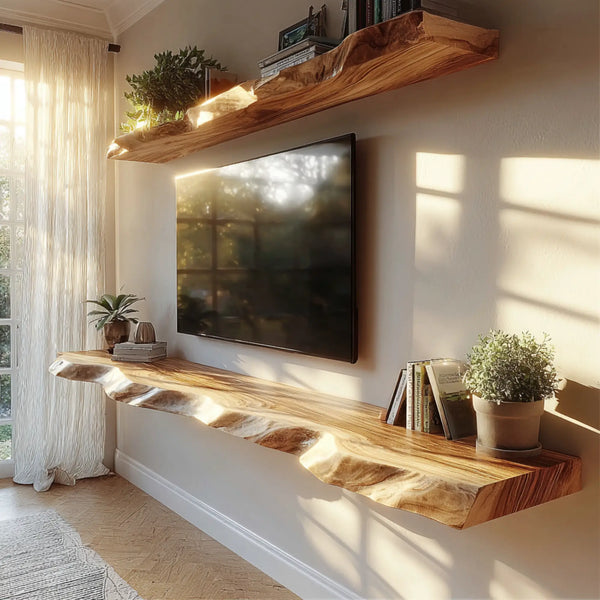
A shelf mounted above a sofa should clear the sofa back by at least 10 inches. This prevents a seated person from sitting up suddenly and making contact with the shelf edge, and it keeps the shelf from visually pressing down on the seating area below.
For a gallery-style arrangement of multiple shelves on one feature wall, 10 to 14 inches between shelves creates a layered display effect with enough breathing room between levels. Tighter than 10 inches and the shelves start to look crowded regardless of what's on them. Wider than 14 inches in a gallery context can break the visual grouping and make the arrangement feel disconnected.
Bedroom Floating Shelves
Bedrooms benefit from slightly more generous spacing than other rooms. A 16 to 20 inch gap between shelves gives the room a calmer, more open quality that supports the function of a sleeping space.
Floating bedside shelves and reading nook shelves that hold books, a lamp, and small objects work well at 12 to 16 inches. This keeps items within comfortable reach from a seated or lying position without the shelf sitting so high that it requires sitting up fully to retrieve something.
Shelves above a desk in a bedroom or reading corner should follow the same logic as home office shelves: 12 to 15 inches for books and notebooks, 15 to 18 inches for larger objects or a small plant.
Bathroom Floating Shelves
Bathroom shelves typically hold smaller items than any other room: toiletries, folded towels, candles, and small decor objects. This allows for tighter spacing without the shelves feeling cluttered.
For general bathroom shelving with a mix of product heights, 8 to 12 inches between shelves is the practical range. Folded towels are the exception: a standard folded hand towel sits about 5 to 6 inches high, but bath towels folded in thirds reach 8 to 10 inches. Allow 12 inches minimum when storing bath towels on open shelves.
Above the toilet tank, leave 10 to 12 inches of clearance above the tank lid. This ensures the tank remains accessible for maintenance and gives the shelf enough visual lift that it does not appear to press down on the fixture below.
Home Office Floating Shelves
Home office shelving is primarily functional, and the dominant item type is usually books or binders, which makes the spacing decision straightforward.
Paperback books average 7 to 8 inches in height. Standard hardcovers run 9 to 11 inches. Oversized reference books and large-format art books reach 12 to 14 inches. Leave 1 to 2 inches of clearance above the tallest items you plan to store, so you can remove and return books without tilting them sideways.
For a home office where shelves also hold plants, frames, or small equipment, 14 to 16 inches gives enough flexibility to mix item heights without any individual item feeling cramped.
Spacing by What You're Storing
The room gives you a starting range. What you're actually putting on the shelf gives you the precise number.
|
Item Type |
Item Height |
Recommended Shelf Clearance |
|
Spice jars |
3–5 inches |
6–8 inches |
|
Paperback books |
7–8 inches |
9–10 inches |
|
Hardcover books |
9–11 inches |
12–13 inches |
|
Glasses and mugs |
5–7 inches |
8–10 inches |
|
Standard plates (stacked) |
6–8 inches |
9–11 inches |
|
Folded hand towels |
4–5 inches |
7–9 inches |
|
Folded bath towels |
8–10 inches |
12–14 inches |
|
Small plants (pot + plant) |
8–14 inches |
12–18 inches |
|
Oversized books |
12–14 inches |
15–18 inches |
|
Large decor objects |
10–16 inches |
14–20 inches |
The formula is simple: measure the tallest item you plan to store, add 2 to 3 inches of breathing room, and that is your minimum spacing. If you plan to mix item heights on the same shelf, base the spacing on the tallest item in that category.
Even Spacing vs. Staggered: Which Looks Better?

Neither approach is inherently better. Each creates a different effect, and the right choice depends on the room and the wall.
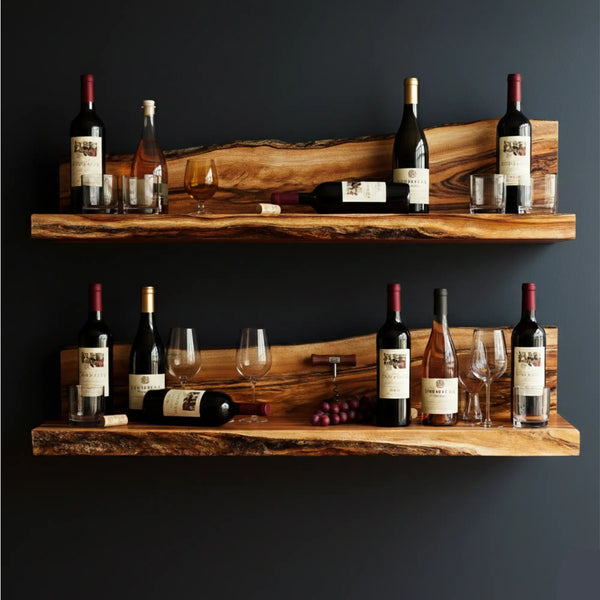
Even spacing (all shelves the same distance apart) creates a clean, structured look that suits minimalist, Scandinavian, and contemporary interiors. It reads as intentional and organized. The risk is that it can feel rigid when the items displayed vary significantly in height, since uniform spacing either wastes room above short items or crowds the taller ones.
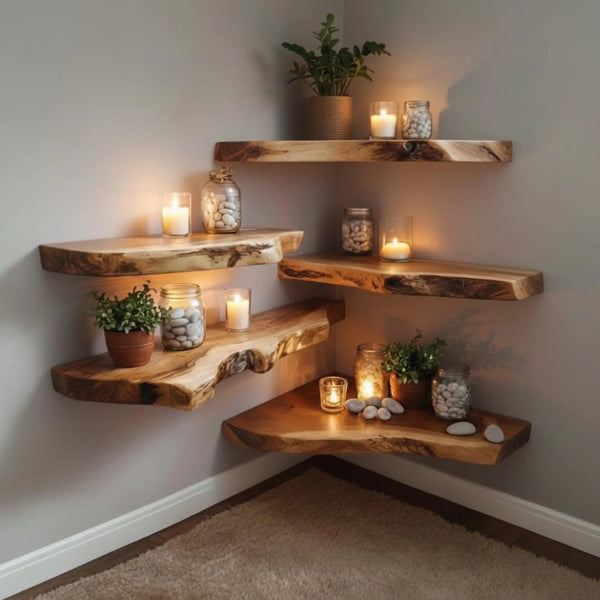
Staggered spacing (varying the distance between different pairs of shelves) creates visual rhythm and allows you to dedicate more space to a row of tall items while keeping tighter spacing for a row of small ones. This approach suits eclectic, bohemian, and organic modern interiors. It also allows the shelving arrangement to respond to the actual height of what's stored, rather than imposing uniform spacing regardless.
A practical starting point for staggered arrangements: put the largest gap at the bottom (where taller or heavier items often live) and tighten the spacing as you move up the wall toward lighter, shorter items. This creates a visual taper that feels balanced without looking symmetrical.
The Rule of Three applies to shelf styling as much as to shelf count: group displayed items in odd numbers of three or five per shelf. This prevents the arrangement from reading as matched pairs and creates a more natural, layered effect regardless of the spacing you chose.
How Solid Wood Shelf Thickness Changes Your Spacing
This is the detail most floating shelf guides miss entirely. Shelf thickness is not a cosmetic detail. It directly affects your spacing measurements and the way a finished wall of shelves reads visually.
A standard MDF or laminate shelf is typically 3/4 of an inch (18mm) thick. When guides say "12 to 18 inches between shelves," they usually assume shelves this thin. The shelf board itself takes up negligible vertical space.
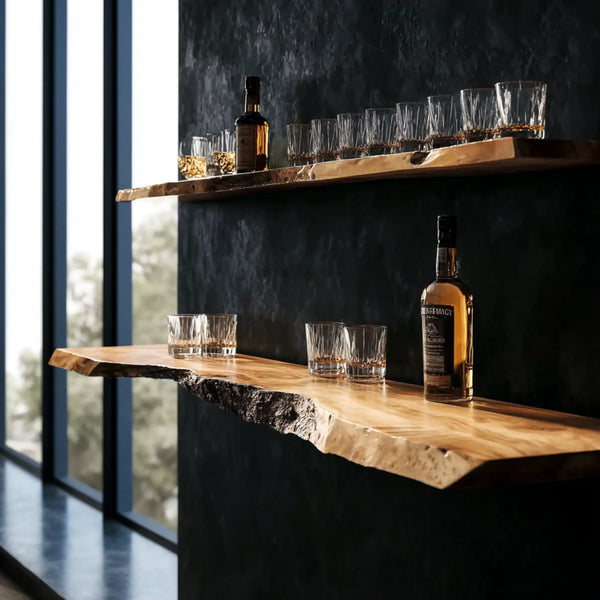
A solid hardwood floating shelf is a different object. A 1.5-inch thick solid oak or walnut shelf has real visual mass. When you stack three of these shelves on a wall, the shelf boards themselves consume 4.5 inches of total vertical height before a single item is placed. On an 8-foot wall where you are planning shelves between 18 and 72 inches from the floor, that consumed thickness matters.
Measure from the bottom of one shelf to the top of the shelf below (the clear opening), not from board center to board center. Mark this distinction on your planning sketch before you start measuring the wall.
Solid hardwood also changes the span equation. A properly dried and kiln-treated solid oak or walnut shelf can safely span 36 to 48 inches between support brackets without sagging under load. MDF and softwood shelves over 24 inches typically require a center bracket to prevent deflection under book weight. This affects where you can place shelves relative to wall studs, which in turn affects what spacing options are available to you structurally.
One more consideration specific to solid wood: seasonal movement. Solid hardwood expands and contracts with humidity changes throughout the year, typically up to 1/4 inch across the width of a shelf. If you are installing solid wood shelves side by side or adjacent to a side wall, leave a 1/8 to 1/4 inch deliberate gap at each contact point. This prevents the shelf from binding, warping, or cracking the wall paint as the wood moves.
Height from the Floor: Where to Hang Your First Shelf
Spacing between shelves is only half the decision. Where the entire arrangement sits on the wall matters just as much.
For display shelves in living rooms and bedrooms, the standard guidance is to center the arrangement around eye level. Eye level for a standing adult averages 54 to 60 inches from the floor. For a single shelf intended as a display ledge, position it at 55 to 60 inches from the floor to the top of the shelf surface.
For arrangements of multiple shelves, position the visual center of the group at eye level. If you are installing three shelves with 14 inches between each, the middle shelf should sit at roughly 57 inches from the floor, with the upper shelf at 71 inches and the lower shelf at 43 inches.
Above furniture, clear the furniture surface first:
-
Above a sofa: bottom of shelf at least 10 inches above sofa back
-
Above a desk: first shelf at least 12 to 15 inches above desk surface
-
Above a countertop: first shelf 18 to 23 inches above counter surface
-
Above a toilet: first shelf 10 to 12 inches above tank lid
For high ceilings (9 to 10 feet), you can extend arrangements higher than the standard range. Running shelves from 24 inches to 84 inches from the floor fills the wall proportionally and takes advantage of the ceiling height without leaving a large blank gap above the top shelf.
How to Plan Your Layout Before Drilling
Measure and mark before you commit to a single hole. The five minutes this takes saves hours of patching and repainting.
- Step 1: Measure your items. Gather the tallest item from each category you plan to store. Measure each one and note the heights.
- Step 2: Calculate your spacing. Add 2 to 3 inches to the tallest item in each row. Write the target clearance for each shelf level.
- Step 3: Map the wall. Draw a quick sketch of the wall at rough scale. Mark the floor, the ceiling, any obstacles (outlets, switches, windows), and the stud locations. Map your shelf positions from bottom to top.
- Step 4: Use painter's tape. Run horizontal strips of painter's tape on the wall at the intended height of each shelf. Step back and live with it for a day. Look at it in morning and evening light. This preview catches proportion problems that are invisible on paper.
- Step 5: Mark and drill. Transfer the tape lines to pencil marks, locate your studs, and install the shelf brackets at the measured heights. Remove the painter's tape before finishing the shelf installation.
Common Spacing Mistakes to Avoid
Measuring shelf-center to shelf-center instead of clear opening. This is the most common calculation error. Measure from the bottom of one shelf to the top of the shelf or items below it.
Ignoring shelf thickness. A 1.5-inch hardwood shelf is not the same as a 3/4-inch MDF shelf in a spacing calculation. Add the shelf thickness to your required clearance.
Spacing for the items you have, not the items you'll add. Leave some flexibility. Items accumulate, and shelves installed too tightly for future growth require reinstallation rather than just rearranging.
Hanging too high. Shelves above 66 inches from the floor become functionally inaccessible for daily use and visually disconnected from the room. Push arrangements toward the 24 to 66 inch zone unless the ceiling is very high or the items are purely decorative.
Making every gap equal regardless of item mix. A wall of evenly spaced shelves where some rows hold tall vases and others hold paperbacks looks awkward. Let the item heights inform the spacing rather than imposing uniformity for its own sake.
Frequently Asked Questions
What is the standard distance between floating shelves?
The standard spacing between floating shelves is 12 to 18 inches of clear vertical space. Kitchen shelves run toward the tighter end (12 to 15 inches) for everyday items. Living room and bedroom display shelves benefit from the wider end (16 to 20 inches). Bathroom shelves with small items can go as tight as 8 to 10 inches.
How high should the first floating shelf be from the floor?
For display shelves in living rooms and bedrooms, center the arrangement around eye level (54 to 60 inches from the floor). Above countertops, place the first shelf 18 to 23 inches above the surface. Above a sofa, clear the sofa back by at least 10 inches.
Should floating shelves be evenly spaced or staggered?
Both work. Even spacing suits minimalist and contemporary rooms. Staggered spacing suits eclectic and organic interiors and allows each row to respond to the actual height of what it stores. For most homes, a combination works well: even spacing within a functional storage zone, with deliberate variation between zones of different item types.
How do you space floating shelves evenly?
Measure the total usable wall height between your lowest and highest intended shelf positions. Subtract the total thickness of all shelves (number of shelves multiplied by shelf thickness). Divide the remaining space by the number of gaps between shelves. This gives you the equal spacing measurement. Mark each position with painter's tape before drilling.
How thick should floating shelves be?
Solid hardwood floating shelves run 1.5 to 2 inches thick. This thickness provides the structural rigidity to span 36 to 48 inches without sagging under load and creates the visual mass that makes a shelf feel substantial rather than temporary. MDF shelves at 3/4 inch are lighter and less expensive but require more support points and show wear faster under daily use.
What is the rule of three for floating shelves?
The Rule of Three is a styling principle: group displayed objects in odd numbers of three or five per shelf rather than pairs or even groupings. Odd-number groupings create a more natural, dynamic arrangement that reads as curated rather than symmetrical. It applies to any shelf spacing and any room.
How much space do you need above a toilet for floating shelves?
Leave 10 to 12 inches of clearance above the toilet tank lid before the bottom of the first shelf. This keeps the tank fully accessible for maintenance and gives the shelf enough visual separation from the fixture below it.
Conclusion
Twelve to 18 inches covers most situations, but the right spacing for your wall is the one built around what you're storing, where the shelf is in the room, and the actual thickness and depth of the shelves you chose.